
How to Get Court Records
Use Arizona Public Access to identify a public case and event history. Use eAccess for available Superior Court civil and criminal documents filed on or after July 1, 2010. When the image is missing or certification is needed, submit the Mohave Records Request Form by email or fax, call the research line, mail the request, or visit a Clerk counter. Limited-court records must be requested from that court.
- Identify the court and exact case number in the public case history.
- Name the document and note its filing date or event date.
- Try eAccess if it is an eligible post-2010 Superior Court civil or criminal filing.
- Otherwise send the form by email, fax, or mail, call the clerk, or visit the correct counter.
- State plain or certified, choose delivery, receive the quote, and pay the approved fee.
- Retain certification validation and confirm the recipient accepts that form.
A general Mohave County administrative records request is not a substitute for a court-case request. Court files go to the Rule 123 custodian that maintains the case.
The Records Request Form expects requester contact information, a case number when known, party names, and a clear list of documents. State whether certification is needed and how delivery should occur. A request for a particular minute entry, order, judgment, pleading, or marriage abstract is more useful than a broad demand for all material. The clerk can then quote the right search, copy, certification, and delivery charges.
Three Mohave Court Record Layers
Docket, filed image, and certified copy are related but distinct. The docket or case history is the chronological index. A filed document is the pleading, exhibit, minute entry, order, or judgment named by an event. A certified copy is a clerk-authenticated reproduction. A free search can offer the first without the second, and only the proper certification process supplies the third.
| Layer | What it provides | Mohave route |
|---|---|---|
| Docket or case history | Dated index of filings, hearings, and results | Public Access and the court calendar |
| Filed document | The actual pleading, order, minute entry, judgment, or public exhibit | eAccess or the file custodian |
| Certified copy | Clerk-authenticated reproduction for official use | The owning clerk or eligible eAccess certification |
Knowing the needed layer avoids paying for a search when the public case number is enough, or ordering an uncertified image when a recipient requires authentication.
eAccess electronic certification is one route for eligible material, but the receiving institution may demand a raised seal or a different clerk product. The current service should be checked before purchase because access fees and download windows can change. A public preview is not a certified record, even when the image appears to be the same filing.
Types of Court Records
The Clerk of the Superior Court in Mohave County holds felony, civil, family, probate, juvenile, and marriage records at that level. Justice Courts hold precinct misdemeanor, traffic, small-claims, eviction, and limited civil files. Municipal Courts maintain their city ordinance, misdemeanor, and traffic case records. Public availability still depends on law, rule, order, format, and custody.
- Docket sheets and chronological case histories.
- Pleadings, motions, answers, and public attachments.
- Minute entries, signed orders, judgments, and dispositions.
- Public exhibits and transcripts when held and available.
- Certified, exemplified, or authenticated copies offered by the custodian.
Mohave Limited-Court Copies Stay Local
Justice and Municipal Court records do not become Superior Court files because the courthouses share a county or building. Kingman/Cerbat, Bullhead, Lake Havasu, and North Canyon Justice clerks keep their own cases. Municipal clerks keep city traffic and misdemeanor files. Order from the court named in the header. The elected Superior Court Clerk cannot certify a limited-court record it does not hold.
Mohave Email Fax Phone Counters
Email the Records Request Form to clerkofcourt@mohavecourts.com. Fax it to 928-718-4930 and mark it “Attn: Research Clerk.” The stated fax workflow says staff will call within three business days for credit-card payment. Phone requests go to 928-753-0713 extension 4089. Mail can be sent to P.O. Box 7000, Kingman, AZ 86402.
In-person requests are accepted at Clerk locations in Kingman, Bullhead City, and Lake Havasu City. The main records counter is 415 E. Spring Street in Kingman. Bullhead and Lake Havasu counters have split hours with a midday closure, while Kingman lists Monday through Friday, 8:00 a.m. to 5:00 p.m. Call before a long trip when archive retrieval or a particular format is needed.
Bullhead's Clerk satellite is at 2225 Trane Road and uses 928-758-0730. Lake Havasu's satellite is at 2001 College Drive and uses 928-453-0701. Those locations serve Superior Court records. A Justice Court at the same complex remains a separate custodian, so the case header must be checked before a request is delivered.
Mohave Superior Court Clerk
415 E. Spring Street
Kingman, AZ 86402
928-753-0713 ext. 4089
What a Court Record Contains
A Mohave County court record begins with identifying data and then collects the filed and court-generated material kept for the matter. Public copies mask confidential identifiers and may omit sealed or protected content.
| Case number | The court identifier, including a category prefix such as CR or CV where used. |
|---|---|
| Pleadings | Complaint, petition, answer, motion, response, reply, and public attachments. |
| Orders and judgments | Signed rulings, minute entries, final judgments, and later enforcement entries. |
| Docket sheet | The chronological index of filed and court-generated events. |
| Hearings | Notices, dates, types, and public results where entered. |
| Exhibits or transcripts | Material available for inspection or copying when public, held, and reproducible. |
Mohave Transcripts Have Another Custodian
A docket entry can prove that a hearing occurred, but it is not a word-for-word transcript. Transcripts are generally produced by the court reporter or electronic-recording custodian. The Clerk's copy page says some exhibits and transcripts are public and may be viewed by visitors, yet access and copying depend on custody, restriction, format, and the record actually created.
Name the hearing date, judge, and case number when asking about a transcript or recording. Do not ask the docket clerk to reconstruct testimony from the case history. Disability accommodation may permit a digital format through the court Accommodation Form or a verbal clerk request.
Some exhibits also present practical limits. A public exhibit may be viewable at the courthouse but difficult to reproduce because of size, media, or custody. Other exhibits can contain restricted information or be subject to an order. Ask what is public, whether inspection is allowed, what format can be copied, and whether redaction or court approval is required.
Certified Copies and Fees
A plain copy reproduces the public record. Certification adds the Clerk's authentication for uses that require proof from the custodian. Ask the receiving office whether it accepts electronic certification, a Clerk certificate, exemplification, authentication, or a raised seal. The published Superior Court schedule took effect December 28, 2024.
| Item | Amount |
|---|---|
| Copy or comparison | $0.50 per page |
| Certification or Clerk certificate | $35 per document |
| Exemplification | $70 |
| Authentication, three seals | $105 |
| Research locating a document | $35 |
| Postage and handling | $8 |
Justice Court schedules list copies at $0.50 per page and several certification, hearing-media, or research items at $33. Do not use Mohave Recorder fees for court records because the Recorder is a different custodian. Phone cards accept Visa, Mastercard, and American Express with a 2.39 percent convenience fee.
The Superior Court schedule also lists a $41 hearing request, tape, or CD; a $35 emailed hearing or case-file link; and a $6 continued-hearing link. These are specific clerk products, not a flat price for every Mohave record request. The custodian should provide the quote before payment, including postage or special authentication when applicable.
Older Mohave Files Need Lead Time
The July 1, 2010 eAccess line describes online document coverage, not destruction of older court files. An older case may require archive retrieval. Supply the exact court and number, name the filing, and ask the custodian about lead time rather than assuming an unavailable icon means the document is gone.
The Mohave copies page presents the request channels.
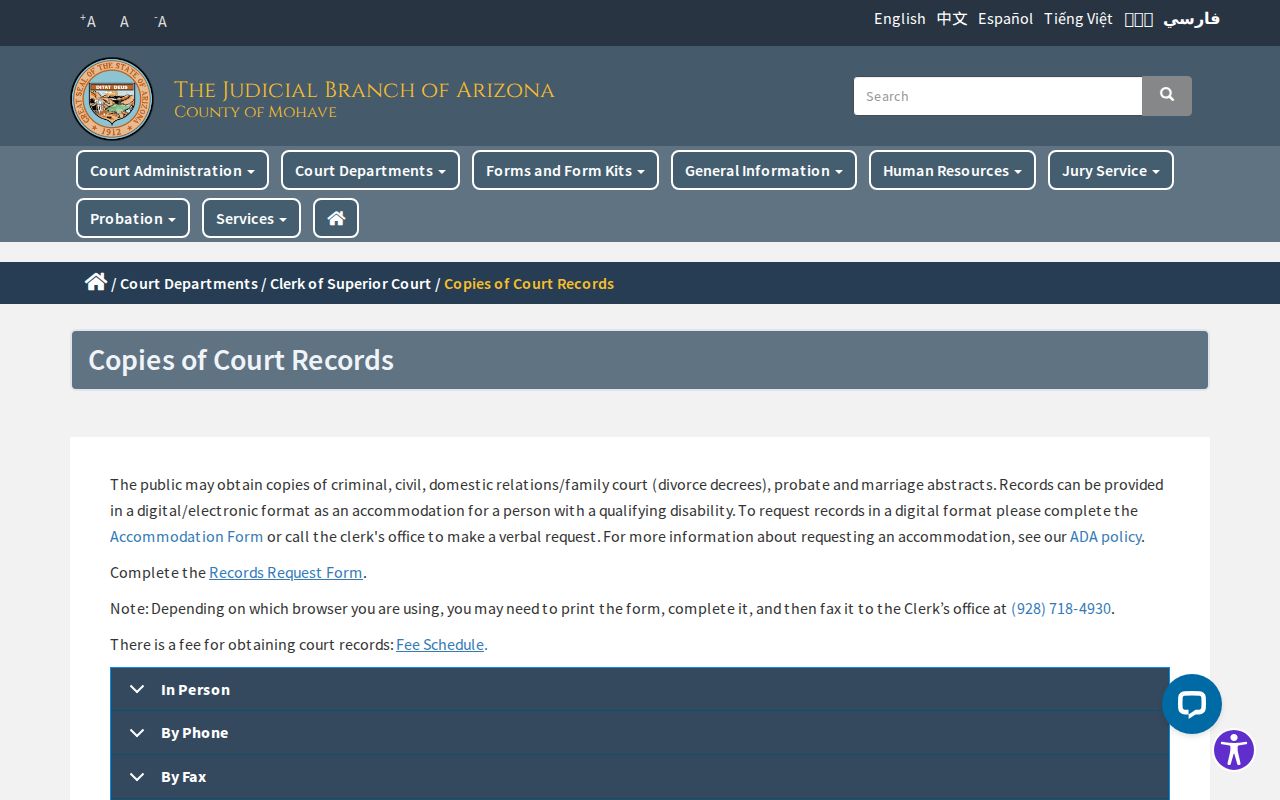
Its clerk-centered workflow is the fallback for filed images, older material, and certified products.
Public Access and Sealed Records
Arizona Supreme Court Rule 123 is the main judicial-record access framework. It defines records, custodians, closed categories, remote access, and review of denials. Remote access may be narrower than inspection at the court. Juvenile, adoption, mental-health, protective-order, sealed, and sensitive victim or witness information can be restricted.
Key Arizona access rules:
Rule 123 governs public access to Arizona judicial records.
A.R.S. § 39-121.01 supplies related maintenance, inspection, mailed-copy, and prompt-response principles.
A Rule 123 denial follows the rule's review process; ask the custodian whether a redacted record can be produced.
The Superior Court clerk fee statute supports the fee framework.
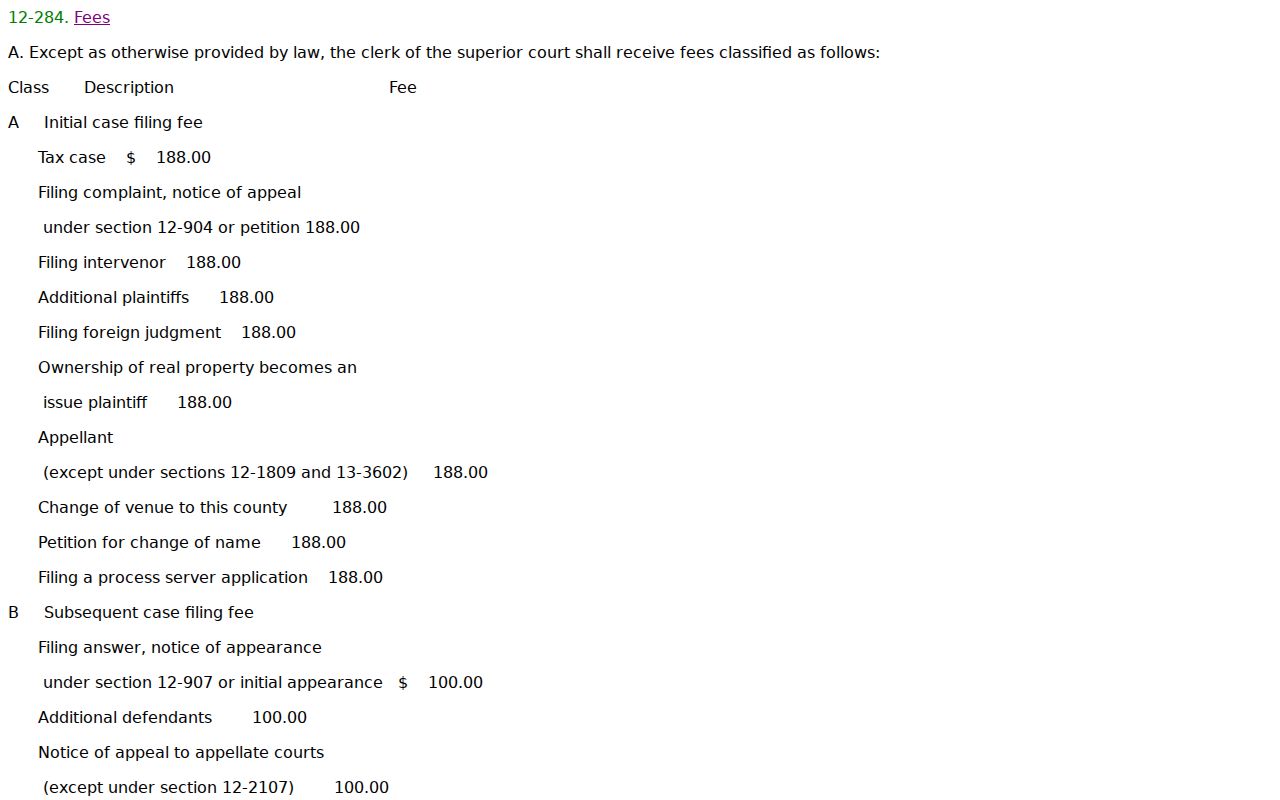
Fee authority does not override confidentiality. Access, redaction, certification, and cost are separate questions for the custodian.
If a known record is withheld, give the custodian its case number and title and ask for the legal basis. A redacted copy may be possible when a full filing is closed. Rule 123 supplies a review mechanism for court-record denials. General Arizona public-record principles also allow a requester to seek the basis for withheld categories where applicable, but a court file must stay in the judicial-record process. The court is not required to create new data or custom analysis merely to answer a request.